
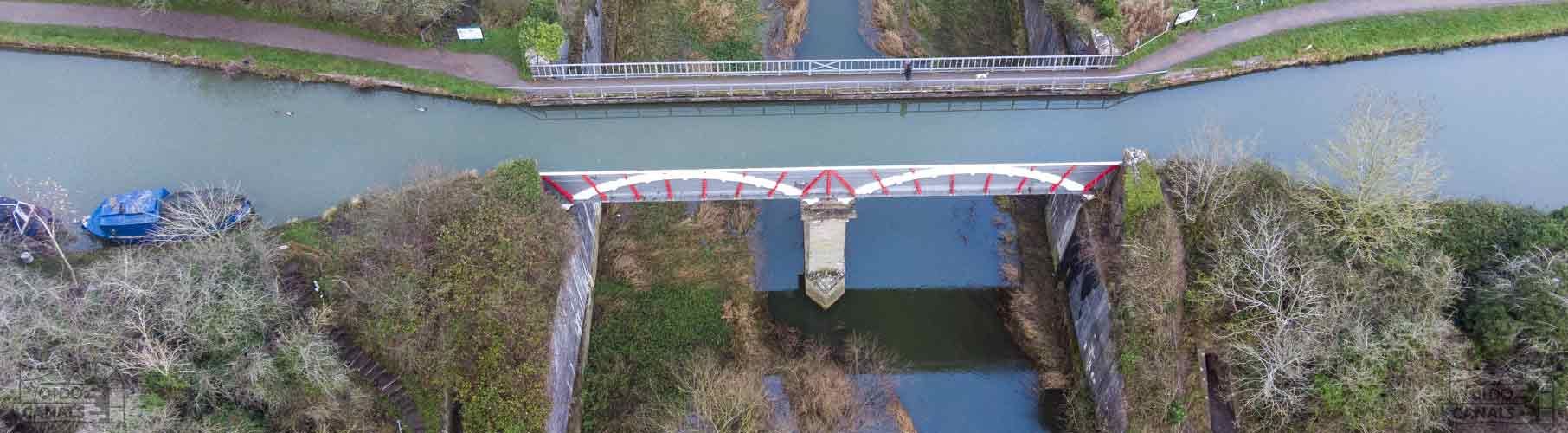
Iron Trunk Aqueducton the Grand Union Canal
 Cosgrove, Milton Keynes MK19 7JR
Cosgrove, Milton Keynes MK19 7JR
Cosgrove, Milton Keynes MK19 7JR
Length - 101 feet
Width - 15 feet
Height - 60 feet
Water Depth - 6 feet 6 inches
The Iron Trunk Aqueduct is one of the most unusual and historically significant structures on the Grand Union Canal. Located near Wolverton in Buckinghamshire, this striking cast-iron trough carries the canal across the River Ouse, replacing an earlier masonry aqueduct. Its construction marked a major step forward in canal engineering, demonstrating how new industrial materials could solve long-standing structural problems.
Today, the Iron Trunk Aqueduct remains a fascinating example of early 19th-century innovation on Britain’s inland waterways.
Location and Purpose
The aqueduct carries the Grand Union Canal (formerly the Grand Junction Canal) over the River Great Ouse floodplain near Wolverton. This crossing was essential to maintain a level canal route between London and the Midlands, avoiding the need for locks and ensuring efficient movement of goods.
However, the river’s tendency to flood created serious challenges for early canal engineers.
When the Grand Junction Canal first opened through this area in 1800, the crossing was made using a conventional brick and stone aqueduct. This structure proved problematic almost immediately:
Despite repairs, the original aqueduct could not withstand the river’s conditions. A completely new solution was needed.
Engineers Involved
The replacement aqueduct was designed by Benjamin Bevan, a highly respected civil engineer and surveyor of the early 19th century. Bevan was a strong advocate of using cast iron for canal structures, recognising its strength, durability, and resistance to water damage. Bevan was highly impressed and influenced by Thomas Telford's aqueducts on the Llangollen Canal.
His work on the Iron Trunk Aqueduct helped establish iron trough aqueducts as a practical alternative to masonry designs.
Dates of Construction
Original masonry aqueduct: circa 1800
Iron Trunk Aqueduct constructed: 1811
Opened to navigation: 1811
The new structure was built alongside the canal with minimal disruption to traffic, a notable achievement for the period.
Special Construction Methods and Design
The Iron Trunk Aqueduct was revolutionary for its time and incorporated several advanced engineering techniques:
This design avoided direct contact between canal water and the river below, greatly improving long-term reliability.
The aqueduct represented a major shift in canal construction philosophy:
At a time when canals were vital to Britain’s industrial economy, maintaining uninterrupted navigation was essential.
Today, the Iron Trunk Aqueduct continues to carry canal traffic as part of the Grand Union Canal, now used almost entirely for leisure boating.
on the Grand Union Canal
Interpretation boards nearby help explain its history, making it a popular stop for walkers, cyclists, and canal enthusiasts.
Few canal structures illustrate the transition from traditional to industrial engineering as clearly as this aqueduct.
Conclusion
The Iron Trunk Aqueduct on the Grand Union Canal is a remarkable piece of early industrial engineering. Built in 1811 to overcome persistent flooding issues, its cast-iron trough design represented a bold departure from conventional canal construction. More than two centuries later, it continues to carry boats safely across the River Ouse, standing as a lasting testament to ingenuity, adaptation, and the evolving science of canal engineering.
Users of the information displayed in this website or in websites linked to directly or indirectly, do so on the basis that it is a guide only. I Do Canals or its directors, partners or associates do not accept any responsibility for inaccuracies, omissions, costs incurred or disappointments of any kind what-so-ever. It is the users responsibility to check directly with any services, displayed, listed or linked to in or from this website, or associated parties with regards to (but not limited to) directions, costs, facilities, services, hospitality, availability, accommodation, etc. There is no implied recommendation for any of the entries or firms listed, nor is any criticism implied for any entry or firm not yet listed.
We have added 111 Waterways and there are 3333 entries listed and displayed on our maps and/or the resource pages:
Waterways Resources -
Boat Build & Fit Out -
Waterside Attractions. We continue to add items on a very regular basis.
Many entries have several services on offer, on average 5 services (some have many more). This means there are approx. 5 x the number of services listed.
Add a Feature or Service to One of Our Website Maps and Lists