
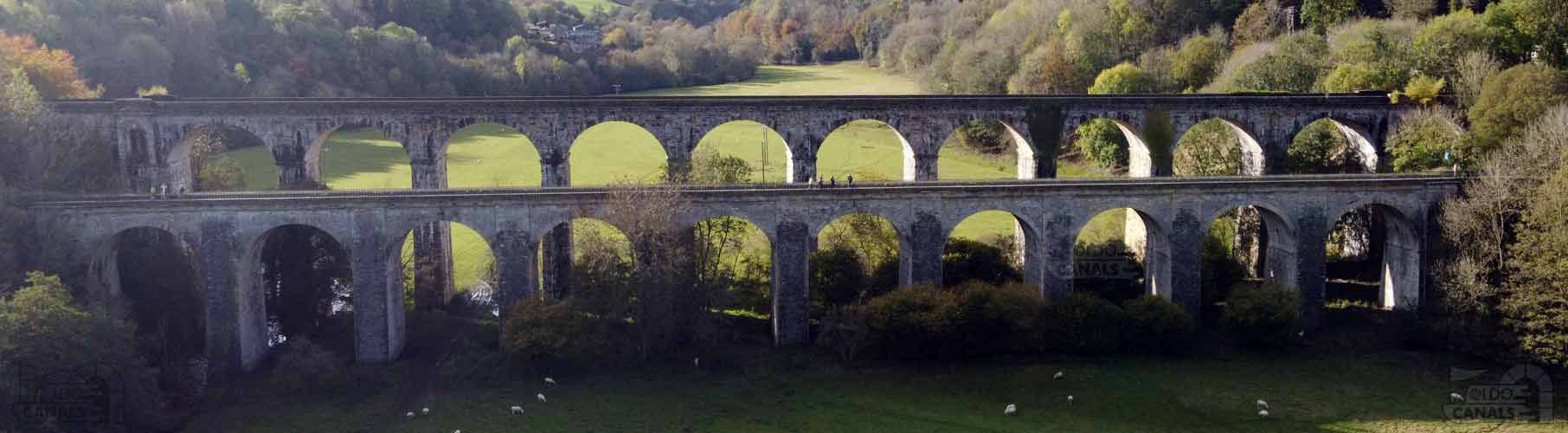
Chirk Aqueduct on the Llangollen CanalA Landmark of Canal Engineering
 Chirk, Wrexham LL14 5DA
Chirk, Wrexham LL14 5DA
Chirk, Wrexham LL14 5DA
Carrying the waterway high above the River Ceiriog on the England–Wales border. Built during the height of Britain’s canal age, the aqueduct is a striking example of early industrial engineering, combining elegance, strength, and practical design.
Today, it remains a vital part of the canal and a dramatic gateway into North Wales for boaters, walkers, and heritage enthusiasts.
Dates of Construction and Historical Background
Construction began: 1796 - Completed: 1801 - Opened to navigation: 1801
Chirk Aqueduct was built as part of the Ellesmere Canal project, an ambitious scheme intended to link the rivers Dee, Severn, and Mersey.
Although the full plan was never completed, the section that became the Llangollen Canal proved hugely successful and remains in use today.
The aqueduct was designed by two of the most important engineers of the Industrial Revolution:
While Jessop provided the overall design leadership, Chirk Aqueduct was one of the projects where Telford’s talent became increasingly evident, particularly in structural design and construction methods.
The purpose of Chirk Aqueduct was straightforward but challenging:
Without an aqueduct at Chirk, the canal would have required steep descents, additional locks, or lengthy detours, all of which would have reduced its commercial value and efficiency.
Chirk Aqueduct is built from local stone and consists of:
The structure runs parallel to the Chirk Viaduct, a railway bridge built later, creating a dramatic double crossing of the valley.
Building Chirk Aqueduct in the late 18th century presented numerous challenges:
The successful completion of Chirk Aqueduct demonstrated the growing confidence and skill of British engineers at the turn of the 19th century.
Chirk Aqueduct is often overshadowed by the nearby Pontcysyllte Aqueduct, completed in 1805 and now a UNESCO World Heritage Site. However, Chirk played a crucial role as a proof of concept.
Lessons learned during its construction helped Telford refine his techniques, directly influencing the more daring iron-built design of Pontcysyllte.
Chirk Aqueduct Today
Today, Chirk Aqueduct:
Remains fully operational and carries regular canal traffic
Is a Grade I listed structure
Forms part of the Llangollen Canal World Heritage corridor
Is popular with walkers and photographers
Offers boaters a dramatic crossing high above the River Ceiriog
For many crews, crossing Chirk Aqueduct is a memorable highlight of a Llangollen Canal cruise.
Why Chirk Aqueduct Is So Important
Built between 1796 and 1801
Designed by William Jessop with Thomas Telford
Enabled the canal to cross a deep river valley without locks
Demonstrated advanced stone aqueduct construction
Helped pave the way for later engineering masterpieces
Chirk Aqueduct represents the moment when canal engineering moved confidently into large-scale landscape-spanning structures.
Conclusion
Chirk Aqueduct is a remarkable achievement of early canal engineering, blending strength, precision, and elegance. Built to overcome the formidable obstacle of the River Ceiriog valley, it played a vital role in the success of the Llangollen Canal and the wider Ellesmere Canal scheme. More than 200 years after its completion, the aqueduct continues to serve its original purpose, standing as a lasting tribute to the ingenuity of William Jessop and Thomas Telford.
Users of the information displayed in this website or in websites linked to directly or indirectly, do so on the basis that it is a guide only. I Do Canals or its directors, partners or associates do not accept any responsibility for inaccuracies, omissions, costs incurred or disappointments of any kind what-so-ever. It is the users responsibility to check directly with any services, displayed, listed or linked to in or from this website, or associated parties with regards to (but not limited to) directions, costs, facilities, services, hospitality, availability, accommodation, etc. There is no implied recommendation for any of the entries or firms listed, nor is any criticism implied for any entry or firm not yet listed.
We have added 111 Waterways and there are 3359 entries listed and displayed on our maps and/or the resource pages:
Waterways Resources -
Boat Build & Fit Out -
Waterside Attractions. We continue to add items on a very regular basis.
Many entries have several services on offer, on average 5 services (some have many more). This means there are approx. 5 x the number of services listed.
Add a Feature or Service to One of Our Website Maps and Lists